Touring India's Temple Towns of Orissa
Magic Carpet Journals takes you to visit
India's mystical temples in Bhubaneswar,
Puri and Konark with Barbara Kingstone
Bhubaneswar is not the centre of the world but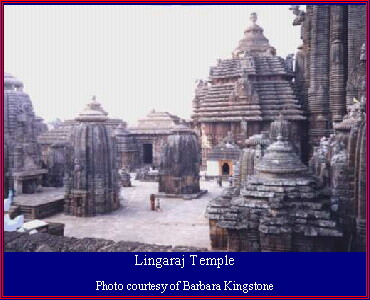 ,
when it comes to temples, it is one of the three
temple towns of Orissa which have become known
as the Golden Triangle - Bhubaneswar, Puri and
Konark. Annually this attracts tens of thousands of
tourists, both Indian and Westerners. Orissa, once
a state with over 7000 temples, has seen its wealth
of temples dwindle to a mere 200 in reasonable
condition which dot the area. A dozen are well worth
visiting.
,
when it comes to temples, it is one of the three
temple towns of Orissa which have become known
as the Golden Triangle - Bhubaneswar, Puri and
Konark. Annually this attracts tens of thousands of
tourists, both Indian and Westerners. Orissa, once
a state with over 7000 temples, has seen its wealth
of temples dwindle to a mere 200 in reasonable
condition which dot the area. A dozen are well worth
visiting.
Bhubaneswar is the sort of city you expect to find
in India - a developing, progressive city that does not forget its past. The capitol of the state of
Orissa, this city of temples is set against the background of high sandstone spires. With a
population of 800,000, Bhubaneswar does not have the hordes of people found in the larger
Indian cities. There are the usual small stalls selling everything from clothing to fruit. My first
evening there I take a walk and pass a doctor's sidewalk
walk-in clinic, with a long line of ailing people. I see small
restaurants and jewelry shops featuring filigree silver work,
a specialty of the area. I learn that telephoning
internationally is a major problem. I have been told that
the cables in my hotel are "shot". But the good news is
there are small booths throughout the country, (really small
- about 3 by 4 feet, where you call out and even fax.)
However, if you want privacy, forget it. The people who
run the stalls love to listen and my presence attracts
passers by, who seem to enjoy my conversation with my
husband in Canada. The cacophony of the traffic noise is
overwhelming since the drivers are "horn leaners". I lose
most of the conversation. Seeing my frustration, the
booth's employee closes the door, but the air quickly
becomes intolerable, so it becomes a no-win situation. The
flip side is that it is really inexpensive, costing only about
46 rupees (approximately CND $2.) for about a
three-minute call.
 "The early morning," Mr. Rath, my guide tells me, "is the
best time to see the temples, as the heat has not yet reached its peak, that by noon can be 40
degrees C., and the worshipers and sightseers have not yet arrived." Mr. Rath, a devoutly
religious man, decides that our first stop should be Laxmaneswar, followed by a hasty visit to
Bharateswar and Satrughneswar, the three oldest temples in the state of Orissa. We do not go to
Remeswar, the baby, since it is only 600 years old. However, the piece de resistance is Lingaraj
Temple, in a class of its own and considered the purest example of a Hindu temple.
"The early morning," Mr. Rath, my guide tells me, "is the
best time to see the temples, as the heat has not yet reached its peak, that by noon can be 40
degrees C., and the worshipers and sightseers have not yet arrived." Mr. Rath, a devoutly
religious man, decides that our first stop should be Laxmaneswar, followed by a hasty visit to
Bharateswar and Satrughneswar, the three oldest temples in the state of Orissa. We do not go to
Remeswar, the baby, since it is only 600 years old. However, the piece de resistance is Lingaraj
Temple, in a class of its own and considered the purest example of a Hindu temple.
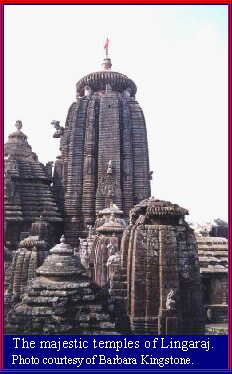
We pass the plethora of souvenir stands, which seem endemic at every temple site. Since Lingaraj
is off limits to non-Hindus, we climb to a rooftop platform and look down on the intricately
carved tower and temple dedicated to Tribhuvaneswar, the Lord of the Three Worlds. Lingaraj
dates back to the 11th century and is ornately and elaborately carved, "a perfect harmony". Within
the complex are another 45 smaller temples. The unusual architecture of a temple includes four
buildings - Sanctum Sanctorum, the Audience Hall, the Dancing Hall, and the Offering Hall, here
all visible from my vantage point. Finished with our visit to the 180 foot temple, we head for the
stairs where we encounter several cows feasting on a pile of garbage. Cows are sacred here in
India, so are allowed to roam freely as they please. I began to think of them as "traffic cops" as
they have the run of the roads too. India truly is a myriad of colors, sounds and odors.
Our next stop is the 7th century Parsurameswar,
 one of the oldest surviving temples and in
incredibly fine condition. The interesting animal
bas reliefs are filled with liveliness.
Parsurameswar's carvings are acknowledged as the
symbol of all that is chaste in sculpture.
Worshiping still goes on here as opposed to the
many temples where there is an admission charge
and are not considered "living temples". The 7th or
8th century Muktesvara Temple, one of the earliest,
set in a garden- like atmosphere, is noted for the
carved colourful arched torana, which is a Buddhist
influence. "God fearing and god loving, that's what
we are," Rath tells me about the Oriyas. We try to beat the heat and race off to the relatively
small 11th century Rajarani, not a living temple and for only 2 rupees you can see the beautifully
carved 9 planets over the entrance. Hidden among the carvings are sensuous female sculptures.
Suddenly, seemingly from out of nowhere, a man appears with a book showing the donations that
previous tourists have made. Rath tells me how much to donate but also warms me that many of
the inclusions I'm being shown in the book have had an extra zero added.
one of the oldest surviving temples and in
incredibly fine condition. The interesting animal
bas reliefs are filled with liveliness.
Parsurameswar's carvings are acknowledged as the
symbol of all that is chaste in sculpture.
Worshiping still goes on here as opposed to the
many temples where there is an admission charge
and are not considered "living temples". The 7th or
8th century Muktesvara Temple, one of the earliest,
set in a garden- like atmosphere, is noted for the
carved colourful arched torana, which is a Buddhist
influence. "God fearing and god loving, that's what
we are," Rath tells me about the Oriyas. We try to beat the heat and race off to the relatively
small 11th century Rajarani, not a living temple and for only 2 rupees you can see the beautifully
carved 9 planets over the entrance. Hidden among the carvings are sensuous female sculptures.
Suddenly, seemingly from out of nowhere, a man appears with a book showing the donations that
previous tourists have made. Rath tells me how much to donate but also warms me that many of
the inclusions I'm being shown in the book have had an extra zero added.
 Before driving to our destination Puri, only 12 km
from Bhubaneswar, is Dhauli, and again considered
one of the oldest monuments in Orissa. It's here
that King Ashoka carved his famous edicts on a
five by three metre rock, still very legible and
guarded behind an iron gate. Nobody is around
and it is a good time to look over the 13
inscriptions, which have been blown up and set in
panel style. Numbers 11, 12 and 13 have been
edited out but I cannot get an answer as to why.
Before driving to our destination Puri, only 12 km
from Bhubaneswar, is Dhauli, and again considered
one of the oldest monuments in Orissa. It's here
that King Ashoka carved his famous edicts on a
five by three metre rock, still very legible and
guarded behind an iron gate. Nobody is around
and it is a good time to look over the 13
inscriptions, which have been blown up and set in
panel style. Numbers 11, 12 and 13 have been
edited out but I cannot get an answer as to why.
With still some energy left, we climb to the top of
the rock so that I can see Elephant Head, claimed
to be the oldest monument in Orissa. Again there
is not anyone nearby. But up the hill is the white wedding-cake like white and gold building,
Dhauli Peace Pagoda. Built in 1972 by the Japanese, it is here the crowds have gathered. Against
the blue sky, there is something very ethereal about the building. The newness for me certainly
does not have the appeal of the antiquities but makes a great photo opportunity.
As the heat settles in, on our way to the coastal city
of Puri, we take a small break at Pipli, a shopping
area. At stall after stall, mirrored umbrellas,
lanterns and handbags are for sale. The only
difference in the sameness of the
 merchandise is the
price. Amongst the Indian people there
seem to be many talented crafts persons who mass
produce these items. As we continue our drive, we
pass orchards of cashew nut trees, which flank the
roadside. The dryness, dust and heat make us
thirsty, so we stop for the liquid of a green
coconut. The vendor is so agile that in seconds the
top is chopped off with a great long sharp knife.
After we sip the sweet and refreshing warm drink,
the nut is chopped open, the meat scooped out and served on half the shell which we eat with a
small scoop that he has made for us.
merchandise is the
price. Amongst the Indian people there
seem to be many talented crafts persons who mass
produce these items. As we continue our drive, we
pass orchards of cashew nut trees, which flank the
roadside. The dryness, dust and heat make us
thirsty, so we stop for the liquid of a green
coconut. The vendor is so agile that in seconds the
top is chopped off with a great long sharp knife.
After we sip the sweet and refreshing warm drink,
the nut is chopped open, the meat scooped out and served on half the shell which we eat with a
small scoop that he has made for us.
I cannot say no to Mr. Rath's suggestion that we stop at the Handicraft Museum in the small
village of Batagan near Puri. I am glad to have the break as the drive has been quite along some
tortuous, narrow, often semi-paved roads. The shop is filled with woodcarving, miniature
paintings and textiles. Since it is also a training centre for the arts, I speak with some of the
students through Rath's translation. The object of the government is to teach these young people
a useful trade. The clay thatched roof huts along the roadside are a sad comment on the housing
conditions in this area. This centre suggests that the government is trying to raise the standard of
living for these people.
Finally, we reach the former port city Puri
an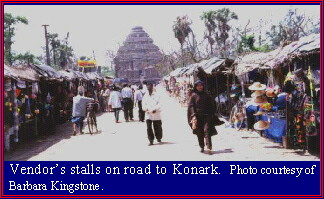 d what a welcoming sight, with the
expansive beach
and the ocean. I am told that the crowds
are not here because of the beach, but the
primary reason is Jagannath Temple, Lord
of the Universe and dedicated to Vishnu.
"Here the past is never forgotten," Mr. Rath
tells me. The temple is even larger than the
one in Bhubaneswar. Since it is not open to
non-Hindus, for a small tip we are admitted
to the roof of the Raghunandan Library to
view the temple's grandness. At the highest point, the temple is 214 feet high. From the far end
of the wide, crowded bazaar-filled boulevard, Grand Road, I can see the massive structure. A
startling fact is Jagannath Temple has the largest kitchen in the world, feeding 100,000 people
each day. To give an indication of its mammoth size, the food is cooked up by 600 chefs who use
only wood fire. Over 25,000 have the food inside the temple grounds, while the rest is sold on
the streets or given to the multitudes of beggars that sit close to the temple gates.
d what a welcoming sight, with the
expansive beach
and the ocean. I am told that the crowds
are not here because of the beach, but the
primary reason is Jagannath Temple, Lord
of the Universe and dedicated to Vishnu.
"Here the past is never forgotten," Mr. Rath
tells me. The temple is even larger than the
one in Bhubaneswar. Since it is not open to
non-Hindus, for a small tip we are admitted
to the roof of the Raghunandan Library to
view the temple's grandness. At the highest point, the temple is 214 feet high. From the far end
of the wide, crowded bazaar-filled boulevard, Grand Road, I can see the massive structure. A
startling fact is Jagannath Temple has the largest kitchen in the world, feeding 100,000 people
each day. To give an indication of its mammoth size, the food is cooked up by 600 chefs who use
only wood fire. Over 25,000 have the food inside the temple grounds, while the rest is sold on
the streets or given to the multitudes of beggars that sit close to the temple gates.
The coup de
grace of the
Golden
triangle of
te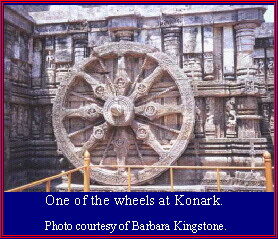 mples is at
Konark,
often
described as
"an allegory
in stone."
It's on the
deserted
coast among
sand dunes,
64 km from Bhubaneswar and 33 km from Puri. With the
traffic and curvy roads, it takes over one hour to get there.
Again there are the vendors and souvenir stands, but the
site is solely for the Temple of the Sun. Built during the
13th century, although still huge, only half the main temple
remains of the former glory. What is remarkable is that
without too much ca
mples is at
Konark,
often
described as
"an allegory
in stone."
It's on the
deserted
coast among
sand dunes,
64 km from Bhubaneswar and 33 km from Puri. With the
traffic and curvy roads, it takes over one hour to get there.
Again there are the vendors and souvenir stands, but the
site is solely for the Temple of the Sun. Built during the
13th century, although still huge, only half the main temple
remains of the former glory. What is remarkable is that
without too much ca re taking, this monument built by an
Orissan king as a victory war memorial is in great condition and the carvings are very visible.
However, recently some thought has been given to its protection. The temple has been
chemically treated and to protect is from the sea salt, trees have been planted between the edifice
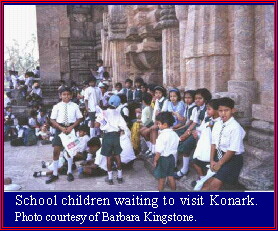
and the beach. Pushing through the groups of school children and tourists, I see that fine carving
covers every inch including the 24 gigantic carved wheels around the base and seven muscular
horses. Nowadays, if Konark is known for anything, it is the erotic carvings. These images are
smaller at the bottom and looking upwards, mostly hidden from view, are life size figures in
various sexual poses, which are most explicit and totally remarkable.
re taking, this monument built by an
Orissan king as a victory war memorial is in great condition and the carvings are very visible.
However, recently some thought has been given to its protection. The temple has been
chemically treated and to protect is from the sea salt, trees have been planted between the edifice
and the beach. Pushing through the groups of school children and tourists, I see that fine carving
covers every inch including the 24 gigantic carved wheels around the base and seven muscular
horses. Nowadays, if Konark is known for anything, it is the erotic carvings. These images are
smaller at the bottom and looking upwards, mostly hidden from view, are life size figures in
various sexual poses, which are most explicit and totally remarkable.
Even for those not involved in any of the religions, The Golden Triangle is worthy of a trip if just
to see the greatness of the temples, their ancient carvings and sheer majesty of size.
By Barbara Kingstone
Return to Magic Carpet
Journals
Return to India
To sign in as a fellow traveler on
this web magazine,
Magic Carpet Journals or to contact us just
click here to
send a message.
Last Updated on
November 07, 2008
by M. Maxine George editor. © 2003
Magic Carpet Journals. All rights reserved