White Water Rafting in Borneo
(Malaysia's Sabah)
Magic Carpet Journals joins Maxine on an adventure into the heart of the former North
Borneo, Malaysia's Sabah, to go white water rafting!
 My itinerary said white water rafting would be part
of our agenda for our second day in Sabah, the
former North Borneo. "That's what they think," I
say to myself. "I might just use that time to get
caught up on the jet lag I am sure to be feeling by
then!" Before we conclude our first day of
sightseeing, our guide, Arthur Augustine, carefully
explains what will be happening the next day. I tell
him that I do not think white water rafting is exactly
right for me, so I will opt out. "I think you will
regret that decision," he responds, "I really think
you should go." Time for me to fess up. "But I
really cannot swim very well," I confide, "Who
would pull me out if I fell in?" Looking straight into
my eyes, he quietly states, "I will!" There is no
doubting the sincerity in his deep brown eyes. From
that moment on I put my trust in Arthur Augustine, a
young man, who is a descendant of Borneo's most
famous head hunter, Monosopiad. Although
dreading the prospect I make the decision to throw
caution to the winds and go for it!
My itinerary said white water rafting would be part
of our agenda for our second day in Sabah, the
former North Borneo. "That's what they think," I
say to myself. "I might just use that time to get
caught up on the jet lag I am sure to be feeling by
then!" Before we conclude our first day of
sightseeing, our guide, Arthur Augustine, carefully
explains what will be happening the next day. I tell
him that I do not think white water rafting is exactly
right for me, so I will opt out. "I think you will
regret that decision," he responds, "I really think
you should go." Time for me to fess up. "But I
really cannot swim very well," I confide, "Who
would pull me out if I fell in?" Looking straight into
my eyes, he quietly states, "I will!" There is no
doubting the sincerity in his deep brown eyes. From
that moment on I put my trust in Arthur Augustine, a
young man, who is a descendant of Borneo's most
famous head hunter, Monosopiad. Although
dreading the prospect I make the decision to throw
caution to the winds and go for it!By the next day, three of our party of seven chose to opt out, using the time for taking pictures or
other options. The remainder of us , board the bus in Kota Kinabulu and begin our journey into the
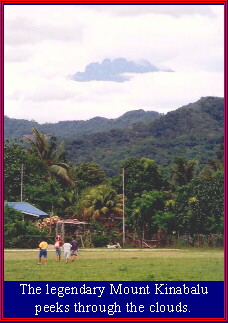
heart of North Borneo. We pass into the hilly countryside, and on past the cloud-covered Mount
Kinabulu, the only mountain in the state of Sabah. For two hours we continue to drive further into
Borneo. Trepidation mounts as our long drive takes us nearer to our destination. Going up
around a hill, we switch back onto a steep road which leads us down to the banks of the Kiulu
River. Waiting for us beside a beached rubber raft, we find the crew, Clay Vincent and Cyril
Motijoejon. Clay is the leader of our expedition. Introductions over, we are told that we will all
have to sign a waiver absolving the company of any responsibility in case of an accident. I was
already having second thoughts about my decision to join this adventure, and this does nothing to
reassure me. However my mind is made up.
Right up until the last minute I have been feeling a
measure of guilt about my decision. I promised
my little granddaughter that I would return home
safely from this trip and here I am taking this
foolhardy adventure!
 Leaving our outer clothes on the bus, we put our
life jackets on over our bathing suits and don
helmets onto our heads. Clay, our leader teaches
us how to put the safety gear on correctly, then checks to
make sure it is properly adjusted and secure.
He begins by giving us a quick course in crewing a raft and raft safety. My first surprise is to
learn that we will not be snuggled down in the bottom of the raft, in fact we will be sitting on the
inflated rubber ring, around the outside of the raft, paddling! We are instructed how to secure our
feet under the inflated bracing or flotation, which crosses the raft. I have on a pair of foam
sandals that I borrowed from the hotel. I did not want to get any of my shoes wet.
Leaving our outer clothes on the bus, we put our
life jackets on over our bathing suits and don
helmets onto our heads. Clay, our leader teaches
us how to put the safety gear on correctly, then checks to
make sure it is properly adjusted and secure.
He begins by giving us a quick course in crewing a raft and raft safety. My first surprise is to
learn that we will not be snuggled down in the bottom of the raft, in fact we will be sitting on the
inflated rubber ring, around the outside of the raft, paddling! We are instructed how to secure our
feet under the inflated bracing or flotation, which crosses the raft. I have on a pair of foam
sandals that I borrowed from the hotel. I did not want to get any of my shoes wet.
 Clay
gives each of us an oar and tells us to hang
onto it no matter what happens. We learn that
there are holes in the bottom of the raft to let
water out that might come in over the sides. We
also learn what to do if the raft flips upside down,
then, last but not least, what to do if the raft flips
and we come up under it. Clay tells us that the
rope that runs inside the inflated sides of the raft
is secure, so we can use it to climb back into the
raft if necessary. We are also taught how to
"body raft." - in other words float down the river
alone, with the buoyancy of our life jackets
keeping us afloat. He describes the journey and
its hazards, letting us know what to expect. With our new knowledge and our gear adjusted, we
are ready for the adventure.
Clay
gives each of us an oar and tells us to hang
onto it no matter what happens. We learn that
there are holes in the bottom of the raft to let
water out that might come in over the sides. We
also learn what to do if the raft flips upside down,
then, last but not least, what to do if the raft flips
and we come up under it. Clay tells us that the
rope that runs inside the inflated sides of the raft
is secure, so we can use it to climb back into the
raft if necessary. We are also taught how to
"body raft." - in other words float down the river
alone, with the buoyancy of our life jackets
keeping us afloat. He describes the journey and
its hazards, letting us know what to expect. With our new knowledge and our gear adjusted, we
are ready for the adventure.
 The raft is pushed into the water. We all clamber
aboard and get into our positions, with oars in
hand. The crew, Clay and Cyril sit at the back..
Arthur and Sham at the front, Lenora and myself
behind them, then Monica and her crutches behind
us. Monica broke her ankle several months ago
and had to have surgery to repair it. She is
approximately two weeks from being able to walk
with it again, so is here with us using crutches to
walk. She is a plucky gal.
The raft is pushed into the water. We all clamber
aboard and get into our positions, with oars in
hand. The crew, Clay and Cyril sit at the back..
Arthur and Sham at the front, Lenora and myself
behind them, then Monica and her crutches behind
us. Monica broke her ankle several months ago
and had to have surgery to repair it. She is
approximately two weeks from being able to walk
with it again, so is here with us using crutches to
walk. She is a plucky gal.
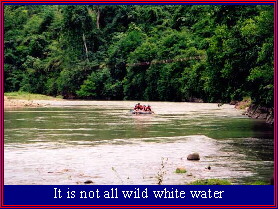
A couple of strokes with our paddles and we are out into the fast flowing water. As the strong
current catches the raft, it turns abruptly. At the same time water comes in the holes at the
bottom of the boat. As my sandals become wet, they become slippery and my feet slip out of
them. With the momentum of the turn, and unsecured feet, I suddenly feel myself going airborne.
I remember being told about the rope. As I begin to fly out over the side of the raft, I reach down
and make a desperate grab for the rope with my
left hand. It stops my exodus long enough that I
am able to twist around and get my right hand
onto the rope too. With the help of that rope I
am able to get back into position on the side of the raft. This
time, I secure my bare feet under the braces. Clay ascertains that I am okay,
then ties the slippery sandals to the
back of the raft. All is well as our adventure proceeds nonstop.
 We are soon approaching our first rapids. We
hear Clay and Cyril shout, "Paddle hard!" and we
all dig into the water with our paddles, stroking
hard to keep from hitting the rocks. For a few exciting moments the raft is buffeted by the
churning, white water. Fortunately my previous
boating experience stands me in good stead - although it was gained many years ago. I remember
how to paddle and how your paddling affects the position of the boat.
We are soon approaching our first rapids. We
hear Clay and Cyril shout, "Paddle hard!" and we
all dig into the water with our paddles, stroking
hard to keep from hitting the rocks. For a few exciting moments the raft is buffeted by the
churning, white water. Fortunately my previous
boating experience stands me in good stead - although it was gained many years ago. I remember
how to paddle and how your paddling affects the position of the boat.
After we pass through the rapids we again have a chance to observe the
scenery. Thick green vegetation lines the shores: rubber trees; palm trees with clusters of yellow
cocoanuts nestled high under the fronds that fan out from the top; banana trees loaded with green
bananas; and everywhere vines growing up and over everything.
Soon the fast moving current
will again turn into white water with deep dips and rises, like a giant roller coaster, throwing the
raft up and down, as we all frantically paddle to avoid the sharp rocks. Each of the rapids is
named and we are told that two are the most dangerous - where the craft can tip. One, called
"Hit the Wall," may cause the raft to flip. As we approach those rapids, I can see it was aptly
named. Directly in front of us, a huge, sheer, rock face borders the narrow, white water channel.
As the force of the current pushes the raft closer to the menacing rock wall, we all paddle
frantically. I know I must paddle very hard to help veer the raft from its collision course. The
imposing, rock wall comes closer and closer. The raft begins to turn - but too late. Suddenly the
threatening, black wall is just inches from my face! I do not scream, but my heart is in my mouth,
as with a thud, the side of the raft, next to me, bounces off that solid, immoveable obstacle. For a
few anxious moments I wonder if the raft will overturn, then I breath a sigh of relief as it
continues upright, choosing a course between an assortment of jagged rocks and the trashing
white water. Once through 'the big one' I know I met the test.
 I keep wishing my tall strapping grandson, Danny
was here with me. I tell the crew about the 6'3"
grandson, who loves to white water raft, back
home in British Columbia. They were amazed by
his height, as many of the men here are between 5'
5" and 5' 9", but these young men here also appear
muscular and in very good physical condition.
I keep wishing my tall strapping grandson, Danny
was here with me. I tell the crew about the 6'3"
grandson, who loves to white water raft, back
home in British Columbia. They were amazed by
his height, as many of the men here are between 5'
5" and 5' 9", but these young men here also appear
muscular and in very good physical condition.
After a while the river widens and we come to a
bend. Our crew brings the raft into shore along the
inner curve at a quiet place in the river. We are
able to jump out and take advantage of the
shallow quiet water for a short swim before
continuing on our adventure.
 In all there are nine rapids that we go through that
day. Occasionally rope bridges cross above us,
over the river. We understand that a settlement
will be found on the other side of the river there.
All too soon we can see a small cluster of buildings up
ahead. We are nearing the end of our journey.
Again the river widens out and flows gently.
Here, we are told we can "body raft" to the end. I
do not avail my self of that option. The raft pulls
up on shore near the buildings. As we climb up to
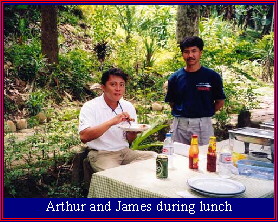
the river bank, we find that James Tongging and
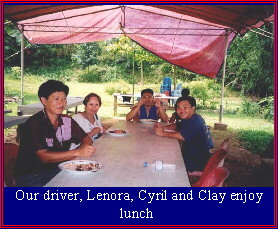
his staff have a nice buffet lunch set up for us, on
tables under the trees, near the beach. I take
pictures of the next group passing on down the river, because we have not been able to take
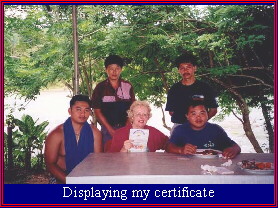
pictures during our adventure, we have been too busy. After lunch the crew present us with
certificates attesting to the fact that we participated in this adventure. I have a T-shirt which says
"Paddle or Die - Survivor," which I proudly wear to show that I actually went White Water
Rafting in Borneo.
In all there are nine rapids that we go through that
day. Occasionally rope bridges cross above us,
over the river. We understand that a settlement
will be found on the other side of the river there.
All too soon we can see a small cluster of buildings up
ahead. We are nearing the end of our journey.
Again the river widens out and flows gently.
Here, we are told we can "body raft" to the end. I
do not avail my self of that option. The raft pulls
up on shore near the buildings. As we climb up to
the river bank, we find that James Tongging and
his staff have a nice buffet lunch set up for us, on
tables under the trees, near the beach. I take
pictures of the next group passing on down the river, because we have not been able to take
pictures during our adventure, we have been too busy. After lunch the crew present us with
certificates attesting to the fact that we participated in this adventure. I have a T-shirt which says
"Paddle or Die - Survivor," which I proudly wear to show that I actually went White Water
Rafting in Borneo.
 As Arthur said, I would have regretted missing
out on this exciting adventure. It just goes to prove that even
great-grandmothers can go white water rafting. I am glad I did it!
As Arthur said, I would have regretted missing
out on this exciting adventure. It just goes to prove that even
great-grandmothers can go white water rafting. I am glad I did it!
Article and pictures by: M. Maxine George
For further information about White Water Rafting in Sabah contact:
Tourism Malaysia (Canada) Malaysia Airlines
830 Burrard St., Vancouver, B.C. V6Z 2K4 Reservations:
1-800-552-9264
Tel: 1-888-689-6872 Fax: 011-603-746-5637
For further information about white water rafting in Sabah
ask about Wildlife Expeditions
@ Tourism Malaysia
Return to Magic Carpet Journals *****
Return to Malaysia
To sign in as a fellow traveler on
Magic Carpet
Journals or to contact us just click
here to
send a message.
Last Updated on
January 21, 2005
by M. Maxine George editor.
© 2003 Magic Carpet Journals. All rights reserved