On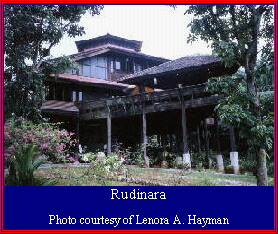 this day our itinerary read that we were to have
a "cultural experience." Assuming it would be
something in the city, I was surprised when the bus
left the city and we were being taken out into the
country. Our guide, Isvaren, had not been given
specific instructions for finding our destination, but
had been told that it would be easy to find as
Rudinara is so well known. The time was well
spent as the ride gave us the opportunity to see the
countryside outside of Kuala Lumpur. Eventually,
after traveling many wrong roads, the bus came to
a halt at the right lane. Here we were met by a
short, slight man, with silvery blonde hair and
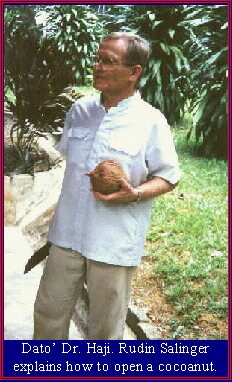
friendly blue eyes peering out from behind his spectacles. We were introduced to Dato' Dr.
Haji.Rudin Salinger, our host for the day. He led us up the
path to his home on a knoll amongst rubber trees and other
plants native to Malaysia.
this day our itinerary read that we were to have
a "cultural experience." Assuming it would be
something in the city, I was surprised when the bus
left the city and we were being taken out into the
country. Our guide, Isvaren, had not been given
specific instructions for finding our destination, but
had been told that it would be easy to find as
Rudinara is so well known. The time was well
spent as the ride gave us the opportunity to see the
countryside outside of Kuala Lumpur. Eventually,
after traveling many wrong roads, the bus came to
a halt at the right lane. Here we were met by a
short, slight man, with silvery blonde hair and
friendly blue eyes peering out from behind his spectacles. We were introduced to Dato' Dr.
Haji.Rudin Salinger, our host for the day. He led us up the
path to his home on a knoll amongst rubber trees and other
plants native to Malaysia.
Dato'
 Salinger was pleased to be able to tell us that his
home was hand built by local craftsmen. Even the lumber
was produced from three native hardwood trees called
Chengal, specially cut, for the purpose, from the ancient
rainforest. Dato' Rudin researched the methods used by
ancient craftsmen and tried to utilize those methods here at
Rudinara. Amazing as it may seem, no nails were used in
the main structure of the house. There is carving over
each door, with the exception of the front door and the
entrance to the first level. The carving was all done by
Haji Wan Su Othman, a designated National Craver, or his
son Hj. Wan Mustafa Wan Su. It took six and a half years
to complete this house. As a result, Rudinara is a unique
and special home, preserving the culture of the area. In
1998 it was winner of the Aga Khan Award for
Architecture, as one of seven special places throughout the
world.
Salinger was pleased to be able to tell us that his
home was hand built by local craftsmen. Even the lumber
was produced from three native hardwood trees called
Chengal, specially cut, for the purpose, from the ancient
rainforest. Dato' Rudin researched the methods used by
ancient craftsmen and tried to utilize those methods here at
Rudinara. Amazing as it may seem, no nails were used in
the main structure of the house. There is carving over
each door, with the exception of the front door and the
entrance to the first level. The carving was all done by
Haji Wan Su Othman, a designated National Craver, or his
son Hj. Wan Mustafa Wan Su. It took six and a half years
to complete this house. As a result, Rudinara is a unique
and special home, preserving the culture of the area. In
1998 it was winner of the Aga Khan Award for
Architecture, as one of seven special places throughout the
world.
Rudin, as we came to know him, told us that he was born in Canada, quite by happenstance. His French parents, happened to be in Canada where his father's engineering job took them at the time. Rudin's own career as a professor, took him to Malaysia during the 1950's. There he met his future wife, Munira, a Malaysian lady. Upon marriage Rudin became a Muslim and wholeheartedly began to learn about the Malaysian culture. Now he is a well-respected authority on the culture of his adopted country.
Under Rudin's tutelage we learned how to open a cocoanut, extract its milk with a kapitan and simpal, then to shave the meat of the cocoanut on a traditional kukur kelapa. Then we were given the opportunity to try the technique ourselves . We made puffed rice and used a stone grinder, known as a kisar, to make rice flour. It was interesting to learn how these and other ancient practical tools, that we were also shown and experimented with, were used.
Following this we were taken to an outdoor cooking area,
with a roof and open sides. Here our host explained how
he prepared our lunch. We saw pots of food simmering
over an open fire. We
 were shown how to make a lacy
bread, known as roti jala on a traditional, outdoor wood
stove. We were all given the opportunity to pour out
some of the lacy bread, onto a hot pan, to cook for our
lunch. While the meal continued to cook over the outside
fires, we were taken back to the patio. Before entering his
home, we all took off our shoes and then washed our feet
with water ladled out of a crockery urn. We followed our
host up the winding stairs to the next level of the house,
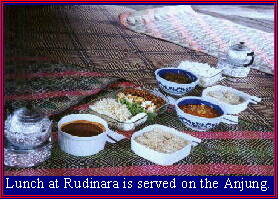
then out onto the deck, known as the Anjung. Our lunch
was to be served out there. After a refreshing fruit drink,
numerous serving bowls were laid out onto large, woven
bamboo mats. There was a tasty assortment of food.
Rudin explained that it is customary to eat the meal
without utensils. He explained how we were to curve our
fingers towards ourselves, then use our thumbs as pushers
to get the food into our mouths. There were bowls for
hand washing. We sat cross-legged on the mat and soon
were all into the spirit of the meal. Some of the food was
quite highly spiced. I only took small portions of those, but found that there were other choices,
with milder spice, more agreeable to my palate.
were shown how to make a lacy
bread, known as roti jala on a traditional, outdoor wood
stove. We were all given the opportunity to pour out
some of the lacy bread, onto a hot pan, to cook for our
lunch. While the meal continued to cook over the outside
fires, we were taken back to the patio. Before entering his
home, we all took off our shoes and then washed our feet
with water ladled out of a crockery urn. We followed our
host up the winding stairs to the next level of the house,
then out onto the deck, known as the Anjung. Our lunch
was to be served out there. After a refreshing fruit drink,
numerous serving bowls were laid out onto large, woven
bamboo mats. There was a tasty assortment of food.
Rudin explained that it is customary to eat the meal
without utensils. He explained how we were to curve our
fingers towards ourselves, then use our thumbs as pushers
to get the food into our mouths. There were bowls for
hand washing. We sat cross-legged on the mat and soon
were all into the spirit of the meal. Some of the food was
quite highly spiced. I only took small portions of those, but found that there were other choices,
with milder spice, more agreeable to my palate.
After
 eating, we were taken outside for a tour of
the garden. Rudin demonstrated how to tap a
rubber tree and told us about other flora and fona
native to this country. We learned that no trees
were felled on this property, except where the
house actually stands. In addition to fruit and
rubber trees, there were sixty assorted native
plants on the property, including cinnamon, cloves
and breadfruit. Some of the plants and trees have
medicinal properties or are used in traditional
cooking. Coming back onto the patio, we were
given a demonstration of the art of batik and soon
some Canadians were putting their artistic talents to work.
eating, we were taken outside for a tour of
the garden. Rudin demonstrated how to tap a
rubber tree and told us about other flora and fona
native to this country. We learned that no trees
were felled on this property, except where the
house actually stands. In addition to fruit and
rubber trees, there were sixty assorted native
plants on the property, including cinnamon, cloves
and breadfruit. Some of the plants and trees have
medicinal properties or are used in traditional
cooking. Coming back onto the patio, we were
given a demonstration of the art of batik and soon
some Canadians were putting their artistic talents to work.
Later we again entered the house and sat around the
large, round, dining table, while Rudin showed us some
of the antiques and artifacts that he has collected during
his life in Malaysia. He explained how these things were
used. It was an informal experience and we joined in
with questions, which he readily answered. What a
marvelous way to learn about Malaysian culture, in a
Malaysian home, with such a knowledgeable tutor. The
surprise though had been that our host was born in
Canada! The knowledge gained, during our time at
Rudinara, gave us an insight into the people and the
traditions of this fascinating country. Our afternoon had
gone quickly and we now had to get back on the road, as
we were late for our next appointment.
we again entered the house and sat around the
large, round, dining table, while Rudin showed us some
of the antiques and artifacts that he has collected during
his life in Malaysia. He explained how these things were
used. It was an informal experience and we joined in
with questions, which he readily answered. What a
marvelous way to learn about Malaysian culture, in a
Malaysian home, with such a knowledgeable tutor. The
surprise though had been that our host was born in
Canada! The knowledge gained, during our time at
Rudinara, gave us an insight into the people and the
traditions of this fascinating country. Our afternoon had
gone quickly and we now had to get back on the road, as
we were late for our next appointment.
Story and pictures by M. Maxine George
For further information or bookings contact:
Tourism Malaysia (Canada)
830 Burrard St., Vancouver, B.C. V6Z 2K4
Phone: 1-888-689-6872 Fax: 011 603 746 5637
Malaysia Airlines
Reservations: 1-800-552-9264
Dato Dr. Haji Rudin Salinger Tel: +60-3-8925 2700 Fax: +60-3-8925 2769 E-mail: [email protected]
Return to
Magic Carpet Journals
Return to Malaysia
To sign in as a fellow traveler on
Magic Carpet Journals contact us just
click here to
send a message.
Last Updated on
January 10, 2006
by M. Maxine George editor. © 2003 Magic Carpet Journals. All rights reserved