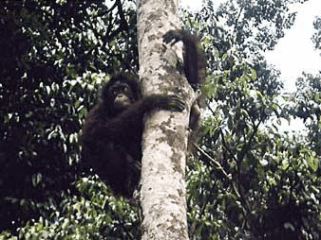
Dropping in for lunch at the Orang-Utan Rehabilitation Centre
Photo courtesy of Margaret Deefholts
Join Margaret Deefholts, as she visits the
Jungle Man of Borneo, the Orang Utan,
via this Magic Carpet Journal
Dropping in for lunch at the Orang-Utan Rehabilitation Centre
Photo courtesy of Margaret Deefholts
From the window of the Malaysia Airlines plane, the rivers of east Sabah look like coiled brown ropes, and somewhere in the thick mangrove swamps bordering them, is an inhabitant of Borneo, which I have travelled half way across the globe to find. The Orang-Utan, (meaning “Jungle Man” in Malay) remains one of the most appealing of all the great apes, and this my once–in–a–lifetime opportunity to see these primates in their natural habitat.
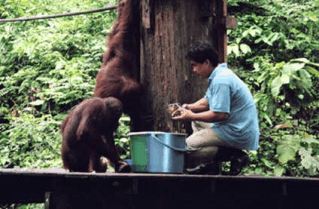
Al, my tourist guide, meets me at Sipadan airport. “Sorry to rush you,” he says, “but we must dash out to the Sepilok Orang-Utan Rehabilitation Centre if we want to catch the Orang-Utan lunch meeting at two o’clock.” I picture a group of anthropoids sitting around a board room table nibbling cheese and crackers. As it turns out the meal is milk and bananas, and the table is large wooden platform suspended by ropes from the branches of a towering Belian tree.

Orang-Utan Restaurant
Photo courtesy of M. Maxine George
Several visitors are gathered at the viewing site, but there is no sign yet of the main guests. Meanwhile, the surrounding jungle is alive with sound and activity: a pheasant screams somewhere in the dense foliage, and a Great Hornbill with a yellow curved beak, surveys us haughtily from his perch on a nearby tree. Then, as a rustle of anticipation sweeps through our group, a female Orang-Utan with a teeny baby clinging to her, leaps onto the feeding deck. The baby stares at the crowd through enormous eyes; mum squats on the platform and gives us a bored once-over. Almost on cue, several others arrive—one of them slides down a pole just behind me, and poses coyly for my camera, while another male plays to the audience with an acrobatic performance along an overhanging vine. “That’s Patrick,” Al says. “He’s maybe around eighteen years old.”
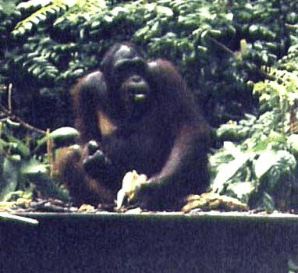
When the forest ranger arrives with a pail of milk and several bags of bananas, Patrick hot-foots it over to grab two bunches of bananas. The ranger smacks his hand gently, and retrieves one lot of fruit out of his grasp. Patrick retreats smirking and makes short work of his share of lunch. A moment later, he’s back to pick up a plastic mug and help himself to a generous scoop of milk. The crowd chuckles, the officer scolds him loudly, and Patrick hangs his head like a naughty schoolboy. His eyes, nonetheless, are unrepentant, and he keeps glancing at us as if to say, “Hey, watch me now, folks, I’m going for the big one!” He does.
Relaxing after lunch
Photo courtesy of M. Maxine George The
officer is at the other end of the platform shooing
away an uninvited long-tailed macaque, and Patrick
lopes over, picks up the entire bucket of milk and
almost succeeds in draining it, by the time the ranger
returns. This time, in response to the officer’s
indignant holler, Patrick bestows a “thanks buddy”
pat on his benefactor’s shoulder, leaps onto an
overhanging branch and, swinging arm over arm,
disappears into the jungle. Patrick is one of approximately fifty Orang-Utans at
the Sepilok Centre, who are currently in various
stages of integration into the wild. Although he is
perfectly capable of foraging for food in the jungle,
he occasionally returns to the feeding platform either
because it’s an easy meal, or because he enjoys his
little games with the forest ranger, whom he has known all his life. This is typical behaviour but as time
goes on, he will move further afield, find a mate and in a couple of years when he no longer shows up at the
feeding area, he will be considered a fully rehabilitated animal. Just hanging around waiting for lunch Photo courtesy of M. Maxine George We stroll back to the main Rehabilitation Centre complex in time to watch an absorbing documentary about
the habits of these gentle primates, and the efforts being made to integrate them back into their natural
environment. Thanks to the aggressive enforcement of a national conservation program by the Malaysian
and Indonesian wildlife departments, the Orang-Utan is no longer on the list of the world’s endangered
species (they number around 25,000-30,000 across Borneo), but the balancing act between commercial and
plantation development vis-à-vis preservation of forest wilderness areas, continues to be a critical issue in
the struggle for survival by these shy, ginger-furred giants of Borneo. .
By Margaret Deefholts
IF YOU GO: Getting There: Malaysian Airlines operates regular flights between
Sandakan and Kota Kinabalu (and thence to other
domestic city terminals throughout Malaysia). The
airline has a well-deserved reputation for efficient
service and excellent hospitality.
Where to Stay: The Sabah Hotel (3 stars) in Sandakan offers visitors
good value for comfortably appointed rooms, a range
of recreational facilities and two restaurants which
serve Chinese, Malay, Indian and Continental cuisine. A feast fit for the king of the jungle Photo courtesy of Margaret Deefholts Tel: 60-89-213-299 Fax: 60-89-271-271
The Sepilok Orang-Utan Rehabilitation Centre This is located 25 km north-east of Sandakan, and is
part of a 43 sq. km. tropical lowland rainforest
sanctuary, which is home to a variety of birds, insects,
reptiles and animals in addition to the Orang-Utan and
the now rare two-horned Asian rhinoceros. Hiking
trails lead through the forest, and although animal
sightings are not guaranteed, the diversity of tropical
trees, bushes, vines and flowers, makes this a
rewarding excursion. The natural history museum at
the centre is well worth browsing through, and it is
recommended (but not essential) that visitors watch the
documentary film before proceeding to the Orang-Utan
feeding platform as this greatly enhances the whole
experience. Feeding times: 10 a.m. and 2.30 p.m. Entrance: RM 10.00 (CA$4.00) Video camera charge: RM10.00 Milk and bananas anyone? Photo courtesy of M. Maxine George Lunch time at the Sepilok Orang-Utan Rehabilitation
Centre Photo courtesy of Margaret Deefholts
For further information about Malaysia
contact: Tourism Malaysia (Canada)
830 Burrard St., Vancouver, B.C. V6Z 2K4
Phone: 1-888-689-6872 Fax: 011 603 746 5637
Malaysia Airlines Reservations:
1-800-552-9264
Return to
Magic Carpet Journals
Return to Malaysia


If you enjoy Margaret's writing you may be interested to know that her book
"Haunting India," is coming out this fall. The book
will be in stores this fall. For further information check the contact
on our links page.

To sign in as a fellow traveler on
Magic Carpet Journals contact us just
click here to
send a message.
Last Updated on
January 24, 2005
by M. Maxine George editor.
© 2003 Magic Carpet Journals. All rights reserved