This Magic Carpet lands in North Africa to explore Tunisia with
Barbara Kingstone
Expecting hot, Tunisian sun, instead I arrive at
Habib Bourguiba Airport on a cold hazy morning.
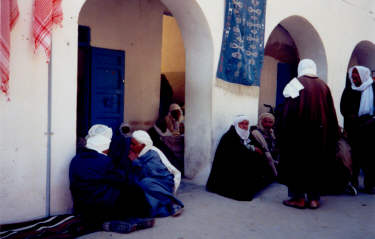
Parkas, anoraks, bournouses wrapped tightly
around the locals are my first glimpse of this
North African country. An unusual cold snap, the
first in two decades, makes them look more like
Canadian in mid-February. But warmth, I soon
discover, exudes from the friendly citizens.
When it comes to getting to know a country, I
have found that driving from one destination to
another allows me the freedom to spend as much
or as little time in a town, village or city and an
opportunity to sense the "texture" of the country.
Here, in Tunisia I'm surprised to find the modern roads are well marked, so getting from A to B,
isn't any hassle.
Hammamet, on the coast and know for glorious beaches, is only one hour away from the
airport and from the city of Tunis. It is my first stop but any thoughts of taking advantage of the
sand and sea are whisked away like the ocean waves. This just isn't bikini weather.
Even though the main focus in this now trendy
destination is sun and sports, I find the
juxtaposition of the walls of the 15th century Great
Mosque and the Medina, a historical thrust back
to another era, makes this the perfect balance for
mind and body. Walking through the Mosque, I
come to the Marabout (mausoleum) of Sidi Bou
Ali, now considered a saint. Inside the small
domed building where he is buried, are brightly
colored fabrics decorating the tomb. There's a
small gathering discussing Bou Ali. I then head to
the top of the fort where there's a panoramic view
of this picturesque place. The sun is shining and
it's a glorious meeting of monotones..blue meets
blue from the sky to the sea. A protective wall was built by the government few years ago to
prevent any further deterioration of the fort.
Hammamet with its 'sweet life', has always attracted intellectuals and artists such as Andre
Gide, Paul Klee and to this day, one of the main attractions seen from where I'm stand, is an
estate built in the 1920s by Romanian millionaire and arts patron George Sebastian. Architect
Frank Lloyd Wright said it was one of the truly beautiful houses he had ever seen and he didn't
even design it.
A stop for both locals and tourists is Sidi Bou Hdid, a café within the mosque's walls. My seat
is a step covered with a Berber rug. Pillows piled against the wall act as a backrest and a tray on
small legs is my table. I order mint tea. A young man next to me happily puffs on a Chicha (
water pipe) and Oum Kathoum (classical music) completes this sybaritic break.
Outside the Medina, near the sea, is a cemetery. I ask Ihsen,
who will accompany me
throughout the rest of the trip, the age of the oldest head stone
is. He looks surprised. "Everyone in our religion
(Moslem) is equal. No head stone is higher, no dates are
shown," he tells me authoritatively. That may have been true
once, but Moslems are now more secular and as I continue my
journey in Tunisia, I do see many dated stones and various sizes.
Across, in a newly build whitewashed 'shopping' center', we
lunch at Les Trois Moutons. This is my introduction to the
country's food. At Ihsen's suggestion I taste harrissa, a very
hot red pepper sauce which the natives call their 'jam'. It's
usual to have it served at the start of every meal. I order
traditional brik, a lightly cooked egg often filled with tuna,
wrapped in a triangular envelope of filo pastry and Mechouis,
grilled and finely chopped vegetables drizzled with olive oil and
topped with fresh tuna. Throughout the journey, I eat a lot of
tuna, which seems to be the national fish. The Muskat Sec de
Kelibia is a crisp white wine of the region and is the perfect
drink with the meal.
Nabeul, only 10 kilometers away, is a more commercially minded city with a population of
400,000 known for its pottery and ceramics. Located on the peninsula of Cap Bon, this old
Phoenician trade harbor was originally named Roman Neapolis. Government buildings flank the
20-minute walk along Ave. Habib Bourguiba (every town and city's main street is named after the
first president), but at the end, there's the breeze off the Mediterranean Sea. On this early Sunday
morning, enveloped in their Sifsari (a large silk or wool shawl which is worn over their clothes),
several women crisscross each other at one of the main intersections providing a most surrealistic
scene. I take pictures.
Not an unusual sight, are large groups of men gathered in coffeehouses drinking 'Moorish"
coffee. Never do I see a woman in these cafes. However, after the Independence in 1956,
women's rights were secured. They attend university and 67% of the dentists in this county are
women.
In the center of Nabeul on Place 7 Novembre, there's a unique landmark a huge pine tree
sitting in a gigantic colorfully painted clay pot.
But far better photo ops are the pottery shops
where the wares are piled high against the outside
walls of the stores, an obvious advertisement of
the city's main trade.
Though often conquered, Tunisia has ended up
winner as it inherited a treasure trove of
archaeological finds. One hundred and twenty
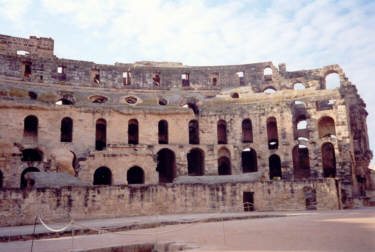
kilometers from Nabeul, is El Jem, with a gem of
an amphitheater dating back to the 3rd century AD
and the only reason to visit. It's smaller than the
coliseum in Rome, but in much better condition
and considered the most impressive monument in
Africa. Originally, there was seating form approximately 34,000 spectators but the population at
its height was only 8,000. Ihsen suggests this was a " demonstration of power". Underneath, are
the still visible chambers that held the gladiators and animals for the spectator sports. The smell is
heavy in this subterranean space. I leave for some fresh air and climb to the top of the arena
where the view is disappointing. There are a few modest cafes, souvenir shops, some houses and
nothing much else. But the 4 Dinar admission includes a visit to a small, splendid mosaic museum
on 7 Rue Fadhel Bouchour. It leaves no doubt that Tunisia has the world's greatest collection of
mosaics. The most extensive collection is at the Bardo Museum in Tunis. Excavators outside,
are recreating a house of the Roman period. Among the garden are foundations, which attest to
the wealth of that era's population. The stone outlines of the rooms are discernible and appear
very large and featuring sophisticated plumbing for that time.
Just forty kilometers way is Madhia. The highway is good and the roadside is thick with olive
trees. It's estimated that Tunisia has over 6 million of this oil producing plants.
There's a definite scent in Madhia and I immediately know I'm in a fishing village. Madhia's
fish market is almost sold out. Buying starts early. From a distance are high walls of a fort. But
it's closed as tight as the moules in the market. (The admission when open, is 2 Dinar). So
instead, we walk down an unpaved roadway past an old all white stoned Arabic cemetery and a
diminutive marina. This leads into a small village where the laundry hangs from sea-worn houses
and eventually to The Black Tunnel (a.k.a. The Dark Passage Skifa el Kahla) and into the
Medina. The only break from the craft shops is the plaza with an outdoor café where again I see
a large grouping of only men.
On the way to Monastir (40 kilometers away), we
pass orchards of Barbary fig and cactus fig trees.
Monastir, a densely populated city, is known
mainly as the birthplace of Habib Bourguiba
(1903). Bourguiba, was the country's first
president (1956-87) after Independence. He is
considered the man who built the new Tunisia,
liberated women, and gave them the vote and
their freedom. He's also credited for disallowing
any manifestation of religious extremists. Men
cannot wear
long bears or
woman,
chadors,
making sure that religion and state remain separate.
The coastline and marina can easily be mistaken for the
south of France. Moored luxury yachts fly flags from German,
Austria and Holland. This seaside oasis with the great
stretches of white sandy beaches once served as Julius Caesar's
base for his African campaign. Today, Monastir ranks as a top
resort destination.
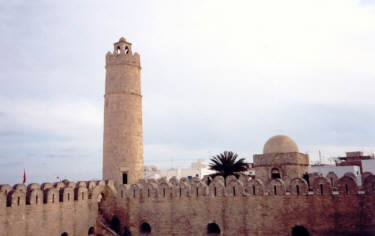
The Ribat (fort) built in the 8th century AD, was a stronghold.
I can't help but observe that hidden away in several nooks and
niches, are young smooching couples. It seems this is still a
stronghold but against kinder and different invaders!
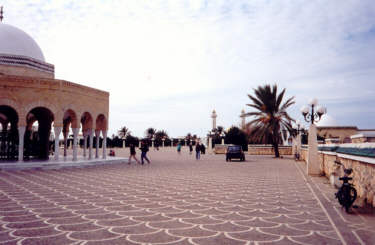
The most important modern complex in the city is at the end
of a patterned brick inlaid esplanade. Very prominent is a twin
towered golden domed mausoleum for the still living former
president. He built this heavily gated monument for himself and until his death, is not opened to
the public. On either side are two green topped domes, one built for his wife and the other for his
parents.
The day ends at the most Westernized cities. Sousse, the
Pearl of the Sahel, has a strategic location, which has been an
invitation for various conquerors. The city, like the county,
became a French colony in the 19th Century. The Germans in
World War II bombed it. However, miracles happen and the
Great Mosque (really a small fort) was spared destruction.
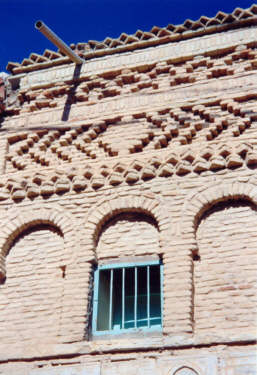
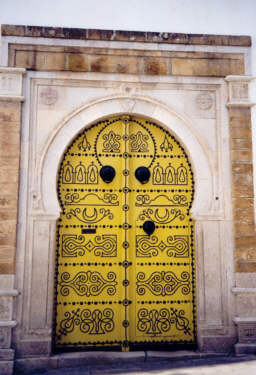
Near the airport, rows of relatively new mammoth luxury
hotels have sprung up in this Cannes-Nice look-alike corniche.
The only give-away that it isn't, is the Arabic styled
architecture.
Port Kantaoui, a suburb of Sousse with a charming spanking
white, fairly new marina, sidewalk cafes, souvenir shops and
modern building development, has a Disney Land appeal. The
Happy Noddy Train deposits the occupants who have come to
see the large international playground of the rich and famous.
As I slip into a deep sleep after a long day, I can't think of more
appropriate words than happy and noddy.
To sign in as a fellow
traveler on this web magazine, Magic Carpet Journals or to contact
us just click here to send a
message. Last Updated on
February 19, 2004 by
M. Maxine George editor.
�
2000 Magic Carpet Journals. All rights reserved
 Expecting hot, Tunisian sun, instead I arrive at
Habib Bourguiba Airport on a cold hazy morning.
Parkas, anoraks, bournouses wrapped tightly
around the locals are my first glimpse of this
North African country. An unusual cold snap, the
first in two decades, makes them look more like
Canadian in mid-February. But warmth, I soon
discover, exudes from the friendly citizens.
Expecting hot, Tunisian sun, instead I arrive at
Habib Bourguiba Airport on a cold hazy morning.
Parkas, anoraks, bournouses wrapped tightly
around the locals are my first glimpse of this
North African country. An unusual cold snap, the
first in two decades, makes them look more like
Canadian in mid-February. But warmth, I soon
discover, exudes from the friendly citizens.
 Even though the main focus in this now trendy
destination is sun and sports, I find the
juxtaposition of the walls of the 15th century Great
Mosque and the Medina, a historical thrust back
to another era, makes this the perfect balance for
mind and body. Walking through the Mosque, I
come to the Marabout (mausoleum) of Sidi Bou
Ali, now considered a saint. Inside the small
domed building where he is buried, are brightly
colored fabrics decorating the tomb. There's a
small gathering discussing Bou Ali. I then head to
the top of the fort where there's a panoramic view
of this picturesque place. The sun is shining and
it's a glorious meeting of monotones..blue meets
blue from the sky to the sea. A protective wall was built by the government few years ago to
prevent any further deterioration of the fort.
Even though the main focus in this now trendy
destination is sun and sports, I find the
juxtaposition of the walls of the 15th century Great
Mosque and the Medina, a historical thrust back
to another era, makes this the perfect balance for
mind and body. Walking through the Mosque, I
come to the Marabout (mausoleum) of Sidi Bou
Ali, now considered a saint. Inside the small
domed building where he is buried, are brightly
colored fabrics decorating the tomb. There's a
small gathering discussing Bou Ali. I then head to
the top of the fort where there's a panoramic view
of this picturesque place. The sun is shining and
it's a glorious meeting of monotones..blue meets
blue from the sky to the sea. A protective wall was built by the government few years ago to
prevent any further deterioration of the fort.
 Outside the Medina, near the sea, is a cemetery. I ask Ihsen,
who will accompany me
throughout the rest of the trip, the age of the oldest head stone
is. He looks surprised. "Everyone in our religion
(Moslem) is equal. No head stone is higher, no dates are
shown," he tells me authoritatively. That may have been true
once, but Moslems are now more secular and as I continue my
journey in Tunisia, I do see many dated stones and various sizes.
Outside the Medina, near the sea, is a cemetery. I ask Ihsen,
who will accompany me
throughout the rest of the trip, the age of the oldest head stone
is. He looks surprised. "Everyone in our religion
(Moslem) is equal. No head stone is higher, no dates are
shown," he tells me authoritatively. That may have been true
once, but Moslems are now more secular and as I continue my
journey in Tunisia, I do see many dated stones and various sizes.
 Though often conquered, Tunisia has ended up
winner as it inherited a treasure trove of
archaeological finds. One hundred and twenty
kilometers from Nabeul, is El Jem, with a gem of
an amphitheater dating back to the 3rd century AD
and the only reason to visit. It's smaller than the
coliseum in Rome, but in much better condition
and considered the most impressive monument in
Africa. Originally, there was seating form approximately 34,000 spectators but the population at
its height was only 8,000. Ihsen suggests this was a " demonstration of power". Underneath, are
the still visible chambers that held the gladiators and animals for the spectator sports. The smell is
heavy in this subterranean space. I leave for some fresh air and climb to the top of the arena
where the view is disappointing. There are a few modest cafes, souvenir shops, some houses and
nothing much else. But the 4 Dinar admission includes a visit to a small, splendid mosaic museum
on 7 Rue Fadhel Bouchour. It leaves no doubt that Tunisia has the world's greatest collection of
mosaics. The most extensive collection is at the Bardo Museum in Tunis. Excavators outside,
are recreating a house of the Roman period. Among the garden are foundations, which attest to
the wealth of that era's population. The stone outlines of the rooms are discernible and appear
very large and featuring sophisticated plumbing for that time.
Though often conquered, Tunisia has ended up
winner as it inherited a treasure trove of
archaeological finds. One hundred and twenty
kilometers from Nabeul, is El Jem, with a gem of
an amphitheater dating back to the 3rd century AD
and the only reason to visit. It's smaller than the
coliseum in Rome, but in much better condition
and considered the most impressive monument in
Africa. Originally, there was seating form approximately 34,000 spectators but the population at
its height was only 8,000. Ihsen suggests this was a " demonstration of power". Underneath, are
the still visible chambers that held the gladiators and animals for the spectator sports. The smell is
heavy in this subterranean space. I leave for some fresh air and climb to the top of the arena
where the view is disappointing. There are a few modest cafes, souvenir shops, some houses and
nothing much else. But the 4 Dinar admission includes a visit to a small, splendid mosaic museum
on 7 Rue Fadhel Bouchour. It leaves no doubt that Tunisia has the world's greatest collection of
mosaics. The most extensive collection is at the Bardo Museum in Tunis. Excavators outside,
are recreating a house of the Roman period. Among the garden are foundations, which attest to
the wealth of that era's population. The stone outlines of the rooms are discernible and appear
very large and featuring sophisticated plumbing for that time.
 On the way to Monastir (40 kilometers away), we
pass orchards of Barbary fig and cactus fig trees.
Monastir, a densely populated city, is known
mainly as the birthplace of Habib Bourguiba
(1903). Bourguiba, was the country's first
president (1956-87) after Independence. He is
considered the man who built the new Tunisia,
liberated women, and gave them the vote and
their freedom. He's also credited for disallowing
any manifestation of religious extremists. Men
cannot wear
long bears or
woman,
chadors,
making sure that religion and state remain separate.
On the way to Monastir (40 kilometers away), we
pass orchards of Barbary fig and cactus fig trees.
Monastir, a densely populated city, is known
mainly as the birthplace of Habib Bourguiba
(1903). Bourguiba, was the country's first
president (1956-87) after Independence. He is
considered the man who built the new Tunisia,
liberated women, and gave them the vote and
their freedom. He's also credited for disallowing
any manifestation of religious extremists. Men
cannot wear
long bears or
woman,
chadors,
making sure that religion and state remain separate.
 The most important modern complex in the city is at the end
of a patterned brick inlaid esplanade. Very prominent is a twin
towered golden domed mausoleum for the still living former
president. He built this heavily gated monument for himself and until his death, is not opened to
the public. On either side are two green topped domes, one built for his wife and the other for his
parents.
The most important modern complex in the city is at the end
of a patterned brick inlaid esplanade. Very prominent is a twin
towered golden domed mausoleum for the still living former
president. He built this heavily gated monument for himself and until his death, is not opened to
the public. On either side are two green topped domes, one built for his wife and the other for his
parents.
 Near the airport, rows of relatively new mammoth luxury
hotels have sprung up in this Cannes-Nice look-alike corniche.
The only give-away that it isn't, is the Arabic styled
architecture.
Near the airport, rows of relatively new mammoth luxury
hotels have sprung up in this Cannes-Nice look-alike corniche.
The only give-away that it isn't, is the Arabic styled
architecture.